

The previous Filter W [Filter Assistant] izard in V11 only listed common variables of the selected directory level. The new Filter [Filter Assistant] Wizard in V12 also offers a variety of filter categories.
Immediately after starting PARTdataManager the filter wizard [Filter Assistant] is still empty. As soon as you select a catalog or a subdirectory in the structure tree, the filter categories are displayed according to the respective catalog (directory). If you perform a full-text search [Full-text search] with an asterisk "*", the possible common categories of all installed catalogs are displayed.
After each filter action the still possible filters are calculated anew and shown together with the new search result.
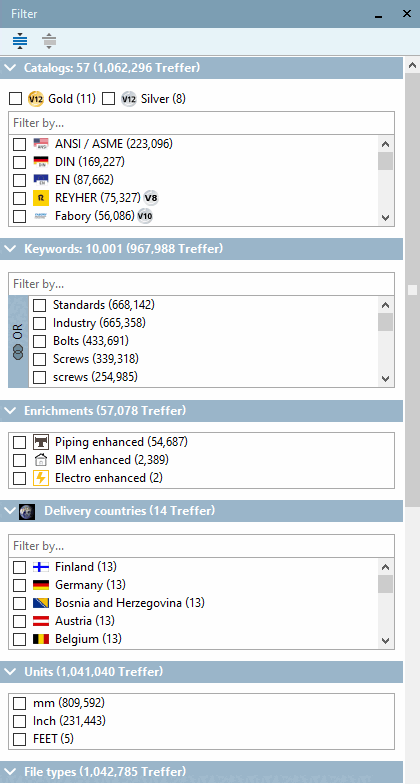

Keywords can be connected with AND
 or OR
or OR  . In order to switch click on the button.
ERP status (e.g. material, usage status, etc.)
ERP variables are displayed over all catalogs.
LinkDB filters work like others, but are colored.
LinkDB filters should be configured by Consulting, as many LinkDB fields do not make sense. E.g. listing the ERP number would lead to thousands of lines, but each only to one result.
RoHS certificate (restriction of hazardous substances in electrical and electronic equipment)
REACH certificate (Registration, Evaluation, Authorization and Restriction of Chemicals)
EMAS certificate (Environmental Management and Audit Schemes)
WEEE (Waste of Electrical and Electronic Equipment) certificate


More than 5 options show scrollable lists with quick-filter (checkboxes).
All selected filters are shown in an overview on top for quick removal or jumping into the respective category.
Furthermore a selected filter is shown on top in its respective category.
In order to delete a single filter, click on the desired filter's x-mark or in order to remove all filters on the x-mark on the right.
The number of remaining results after each dynamically adjustment is shown in brackets. (The real number could slightly differ due to complex value ranges in tables.)
In complex tables it is possible that a selection leads to zero results. In that case the last state is displayed again with a message.


When searching within a single catalog, the common variables of the current selection (catalog or subdirectory) are displayed below the above-mentioned categories (as already known from V11).

With numbers, sliders or checkboxes appear, with text, checkboxes.
Parameters are displayed according to the frequency of occurrence in the catalog. However, they can also have been set by catalog modeling (explicitly added keywords).
Description texts of variables can be different even inside a catalog, so the most frequent are directly shown and the rest in a tooltip.
